web
analytics

Analysis

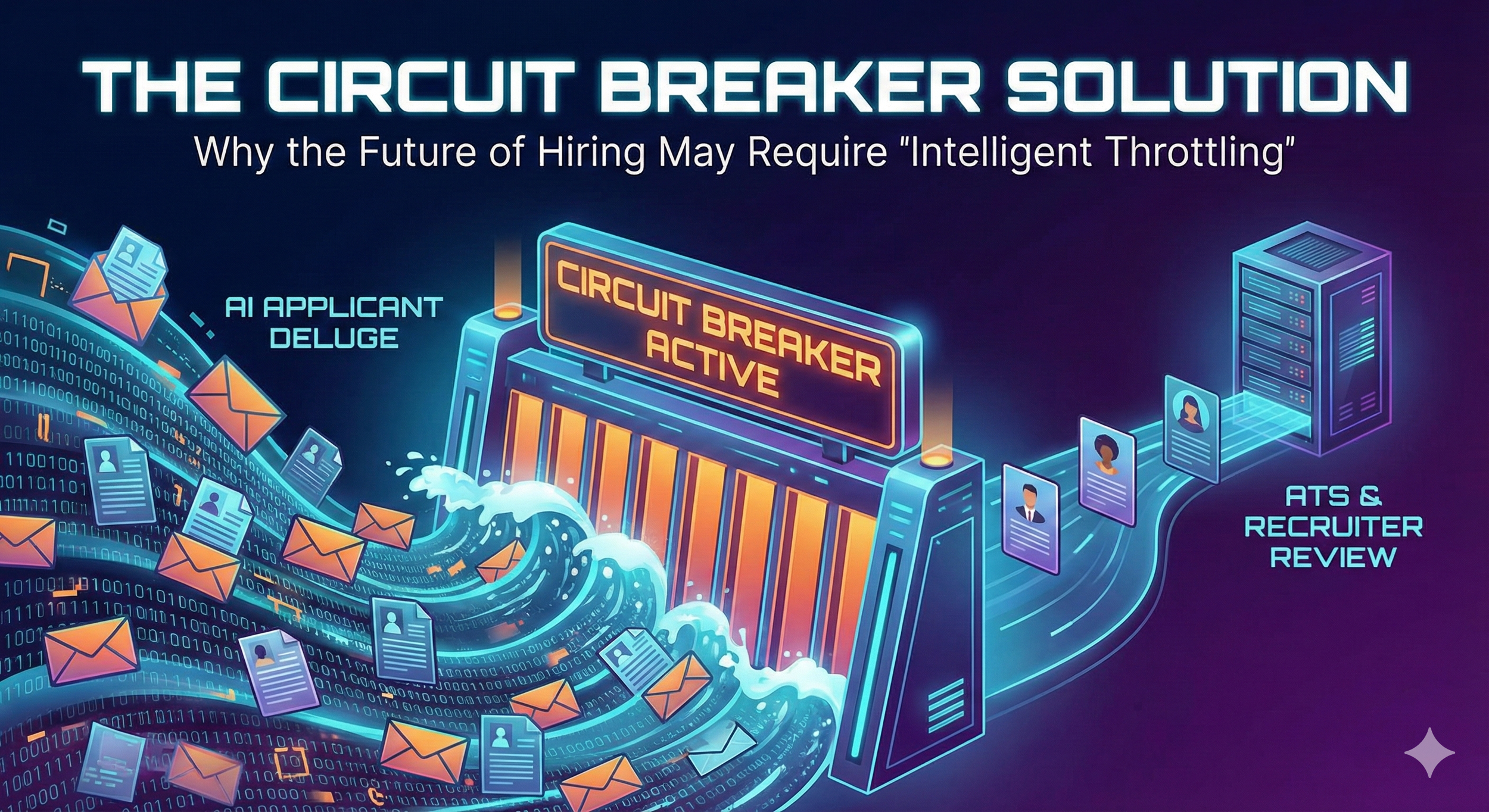
Why the Future of Hiring May Require "Intelligent Job Throttling"

The Monday morning scene for a modern recruiter often looks like a digital disaster movie. You open a requisition on Friday afternoon. By 9:00 AM Monday, your ATS dashboard isn't just busy; it’s hyperventilating. 3,000 applicants. For one mid-level role.

We are living through a unique convergence in the labor market. A wave of high-profile layoffs has created a massive pool of eager talent. Simultaneously, generative AI has democratized corporate-grade automation for the individual job seeker. Tools that auto-apply, perfectly tailor resumes to keywords in milliseconds, and blast applications across platforms are now commonplace.

We have removed all friction from applying. The result isn't a talent pool; it's a talent deluge.

The Current Defense: Identity vs. Volume

Employers and ATS vendors are realizing that the old floodgates cannot hold. We are seeing the first signs of a defensive build-up.

Recent moves, like Greenhouse Software partnering with CLEAR for verified identity, are excellent steps toward combatting outright fraud. They ensure the person applying is a real human being, not a bot farm or a bad actor trying to phish corporate data.

But solving for identity does not solve for volume.

5,000 verified, real human beings applying to a job in 24 hours is still an unmanageable crisis for a human recruiting team. It leads to reviewer fatigue, inevitable "ghosting" (because who can send personalized rejections to thousands?), and a degradation of the candidate experience for everyone involved.

If the candidate side is using AI designed for speed and volume, the employer side needs an AI countermeasure designed for pacing and control.

The Future Concept: Intelligent Job Throttling

The next necessary evolution in ATS technology might be controversial, but it seems increasingly inevitable: AI-driven velocity throttling.

Imagine an ATS feature that functions like a stock market circuit breaker.

When the stock market crashes too fast, trading is automatically halted to allow cool heads to prevail and prevent panic. Why don't our job postings have the same mechanism?

How it might work:

An AI layer within the ATS monitors incoming application velocity against historical benchmarks for similar roles.

  • Scenario: A remote marketing manager role usually gets 50 apps on Day 1. Today, it receives 400 applications in the first hour due to an AI-applier tool targeting the post.

  • The Trigger: The ATS recognizes this anomalous velocity.

  • The Throttle: The AI automatically initiates a tiered response without human intervention:

    • Tier 1: The job posting is immediately de-indexed from free aggregators (Indeed, LinkedIn feed, etc.).

    • Tier 2: The "Apply Now" button on the career site changes to "Join Talent Community Waitlist."

    • Tier 3: The requisition is temporarily paused entirely, becoming invisible externally until the recruiter reviews the initial batch.

The uncomfortable Necessity

The immediate reaction to this idea from job seekers will likely be frustration. It feels like creating artificial scarcity. It feels unfair to the person who wasn't at their computer at the exact moment the job went live.

However, we must confront the reality of the alternative.

If a recruiter has 3,000 applications, they are likely only reviewing the first 100-200 anyway before they find enough qualified candidates for phone screens. The remaining 2,800 people are already being functionally "throttled"—they just don't know it yet. They are left hoping for an email that will never come.

Intelligent throttling offers a difficult but perhaps more honest approach. It stops accepting applications when the capacity to review them humanely has been exceeded. It protects the recruiter’s bandwidth, ensuring the candidates who did get in receive actual consideration, rather than a 3-second glance.

The AI Arms Race Continues

We are in the midst of a great re-balancing of power in hiring, driven by artificial intelligence. As soon as one side gains a technological advantage in speed, the other side must develop a countermeasure.

If candidates are going to use AI to accelerator pedals to the floor, employers have no choice but to install AI-powered brakes. Intelligent throttling may soon move from a hypothetical concept to an essential survival tool for the modern Talent Acquisition department.


Get the Podcast | Subscribe

HR Tech Marketing Masters: How the Top Vendors Set the Industry Standard

I am a marketer by heart and as someone who has grown up in the HR technology industry over the past 20 years I have come to appreciate good marketing when I see it. And I also cringe when I see marketing fail.

Over the past few years our industry has seen an influx of vendors come to market with various software solutions for HR and recruiting, but for the most part these vendors fail to market themselves properly. They don’t stand out in a sea of other vendors. Their messaging is off. They fail to capitalize on media wins, they don’t invest in building their brand. 

I could go on.

Today we are living in the golden age of HR technology which means the space is crowded and getting noisier every day. Only the vendors who invest in their brand awareness will survive and thrive now that the job market is normalizing. 

Of course you’ll need a good product market fit too. If there’s one thing I learned in Marketing 101, even the best advertising won’t sell a bad product.

Founder Led Marketing

For startups in our space, those with founder led marketing strategies tend to get more traction if the founder is an outspoken/communicative champion for the brand.

There are many benefits to founder-led marketing for a software company. Some of the most notable benefits include:

  • Authenticity and credibility: Founders are often seen as the most knowledgeable and passionate advocates for their products. This can give their marketing efforts a level of authenticity and credibility that is difficult to replicate with hired marketers.

  • Deep understanding of the product and market: Founders have a deep understanding of their product and the market they are operating in. This allows them to create marketing campaigns that are targeted and resonate with their ideal customers.

  • Flexibility and agility: Founder-led marketing teams are typically more flexible and agile than traditional marketing teams. This allows them to quickly adapt to changing market conditions and make decisions without having to go through layers of bureaucracy.

  • Cost-effectiveness: Founder-led marketing can be a very cost-effective way to market a software company. Founders can often leverage their own personal networks and relationships to reach potential customers.

  • Passion and enthusiasm: Founders are often passionate and enthusiastic about their products. This passion can be contagious and can help to create a positive buzz around the company.

Of course, there are also some potential challenges to founder-led marketing. For example, founders may not have the time or expertise to handle all aspects of marketing. They may also need to be careful not to let their personal opinions and biases cloud their marketing judgment.

If you are a founder of an HR tech startup, I encourage you to consider using founder-led marketing to reach your target audience. Founders can build relationships with key influencers in their industry. This can help to generate positive word-of-mouth for the company. With careful planning and execution, founder-led marketing can be a very successful way to market your software company.

Memorable examples of founder led startups include;

  • Amit Parmar of Cliquify, I see him everywhere at events and making the rounds on industry podcasts talking about employer branding and the Cliquify platform. He is constantly on the go.

  • Job van der Voort of Remote.com: Not only does he have the best first name in the industry but he leads arguably the best vendor in the global payroll category. I see Job’s name all over the news.

  • Aman Brar of Canvas: A few years back, Canvas was a hot text recruiting startup led by its jovial leader Aman Brar. The company was later acquired by Employ Inc.

  • Adam Gordon of CandidatedID: acquired by iCIMS last year, Adam Gordon led the CRM platform from start to finish. He was a constant champion of the tool online and off.

  • Daniel Chait of Greenhouse: back in the 2010’s Co-founder Daniel Chait led the charge for what would become an ATS powerhouse.

  • Johnny Campbell from SocialTalent: I remember Johnny was ever present on the conference circuit touting the benefits of their recruiter learning platform and talkin’ tactics. If there was a panel he was on it.

I’ll also give a shoutout to a couple of rising stars, Mark Simpson (Pillar) and Darrian Mikell (Qualifi).

HR Tech Marketing Masters

I asked my network which companies stand out in their minds, here’s the names that came up most often.

  • Plum: ”The way they showed up at RecFest and their online marketing is just so well done. Leaders are true experts and share on LinkedIn too. (Will Staney) Plum definitely stole the show at HRtech with an amazing "All you need is Plum" play, inspired by the Beatles LOVE By Cirque du Soleil event they sponsored. If that wasn't enough, you could create your own Beatles inspired t-shirt at their exhibit.” (Ryan Affolter)

  • HireEZ: Probably the best example of leveraging community. They are famous for getting early traction in the recruiter community by leveraging influencers and fostering a community around their sourcing platform.

  • Phenom: One of the most consistent firms in our space. They are masters at content creation, events (virtual/in-person) and staying engaged with all facets of the recruitment industry. They’re persistent too…you see their efforts week in and week out.

  • HiBob: Great at event marketing. I always tend to notice their booth and offering. AT HR tech they are always near the front with massages or profile photo shoots.

  • Paradox.ai. “They are very consistent in their digital and offline visual identity. And in today's market, they are bringing to the forefront outcomes data as social proof.”(Bennet Sung)

A HiBob ad from Facebook. Love the Austin Powers angle they took.

Plum has come on fast in the past year with a great event strategy and its outreach online with influencers, podcasters and others in the space to highlight the Plum brand. The HireEZ marketing team led by Shannon Pritchett, are masters at building community around a software product.

Phenom, who I know well, is a well oiled marketing machine and is particularly great at content. They also do a great job at keeping influencers and analysts up to date with emails like their Analyst Newsletter which I get monthly.

I asked my friend Tim Sackett, Mr. “HR Famous” himself, who he thinks are the best marketers. 

He had a lot to say;

“That’s a big question”, he said over an email exchange…“because it could be broken down into who does the best job within the community, and who does the best job overall. Because that leads to who is the real buyer? If you look at Workday, Oracle, SAP, and the "Pays" all the payroll companies do the best job. You see them everywhere and obviously, they have massive budgets to get their brand in front of everyone.”

But a big budget doesn't mean the best marketing that resonates with buyers. The big vendors all have their own conferences these days and seem to mimic each other so I don't see much differentiation among them. It can come across as rather generic marketing. But payroll tech is not that sexy so…

In terms of the Big 3- WD, Oracle, SAP – “they know the real buyer at the enterprise level is the CFO, CIO, and CEO” Sackett added. “That’s why you see them sponsoring PGA events, sailing, etc. It's big money stuff that most people can’t afford, but those kinds of titles can. In terms of the payroll companies, it’s about establishing your brand everywhere because it’s so easy to switch from one to the other, and they all cost basically the same and do 90% of the same stuff. But, when that HR leader, payroll manager, or office manager gets frustrated, you better be top of mind because they are most likely only making one call to switch.”

The vast majority of HR and TA technology is not bought. It’s sold.

~Tim Sackett

The best vendors are the ones who definitely have a brand but are also great at selling and following up. And that isn’t always the best technology. They are just the best at selling it.

“I like what BambooHR does on a consistent basis”, Sackett continued. “They might be the best HR technology company on the planet in terms of creating lead generation. BambooHR got there by building a massive content marketing machine, and they feed it constantly, and by creating a massive email marketing engine. Any week of the year, BambooHR has informational webinars running with topics that HR professionals find interesting that others might find boring. They are constantly educating HR pros for free, and it’s amazing branding.

The other one that is hard to miss is Eightfold. It doesn’t matter what enterprise CHRO or Head of Talent I’m talking about; they will ask me about Eightfold. Eightfold also has a rather large budget for marketing and not a lot of competition in what they do. Still, they have also done a great job in content marketing and making sure they are a part of every conference and opportunity to be in front of their potential users and buyers.

Building brand awareness isn’t some secret sauce. It’s about a conscious, consistent effort to get your message out. And stay on message. As marketers, we tend to get tired of hearing our own message, but a small fraction of your audience actually hears it each time you broadcast it. You need to beat the drum over and over and over, then beat it some more. We hate to hear this, but it’s also about building a lead gen list of emails and contacts that you can consistently message to and never stop building and refreshing.”

He’s right about the messaging. I’ve seen too many vendors muddle their unique value proposition with too many buzzwords which tends to just confuse potential buyers. You need to quickly tell buyers what problem it solves and consistently (and persistently) hammer home that message with your prospects.

Recruiters are not technologists. So I’ve always felt you have to simplify and clarify your message into terms they understand. Speak their language and don’t over complicate your pitch.

What Buyers Want

Sarah White, Founder of Aspect43 a strategy and analyst group focused on HR Tech, conducts an annual Insights at Work research, a yearly study looking at how technology is impacting employees, HR and leaders at work. As part of that, they conduct voice of customer research and how buyers want to engage differently with vendors during the marketing and sales process.

Here’s a few numbers to chew on from their most recent data.

  • 60% want more stats/research from vendors

  • 45% want more infographics

  • 40% want more video demos on vendor website

  • 39% want more expert led webinars

  • 75% of all buyers want fewer sales calls/emails

  • 36% want more regional roadshow events

  • 40% of buyers use conferences to shortlist vendors

  • 54% say brand is essential to get a signed contract

  • 94% use brand awareness to inform buying decisions

Those last two stand out to me. Brand awareness has to be there if you want to be a player. To do that you must have a consistent presence offline as you do online. 

And you have to invest in metrics for the industry. The more you can prove your product works with studies and reports, the more ammunition you’ll have to back up your claims. That includes case studies and detailing how clients are successful with it.

MARKETING RESOURCE: 2024 HR and Recruiting Event Calendar

Fostering Community

Engaging the community online and off is another key to great HR tech marketing. There are dozens of groups across social media where recruiters and HR pros gather to talk shop in an unfiltered way. Vendors can learn a lot about their struggles and day to life by lurking in them.

Back when sourcing platform HireEZ was known as Hiretual they did one of the best jobs I’d ever seen by a vendor when it comes to leveraging these groups and channels to drive product adoption. They gave away their tool to some of the top sorcerers in the industry and let them drive the conversation about the product. I first learned of the tool from the various recruiter facebook groups where people were talking about it and showing it off. It was a very grass roots approach that put them on the map.

Then when Hiretual changed its name to HireEZ they flew out 30 of the top influencers (including me) to silicon valley to announce the news and their latest funding round. That effort both them tons of mentions and goodwill in the TA community.

I asked their Head of Marketing Shannon Pritchett how they foster community around their software. She writes;

“Fostering a thriving community means embracing service, active listening, and continuous support beyond merely delivering a product. We value every user's input, acknowledging that we don't possess all the answers. Our inclusive approach builds belonging and ownership within the community, essential for success.

With a servant-leader mindset, we prioritize the community's needs, offering resources like the Outbound Recruiting Academy and facilitating connections to encourage collaboration. Trust is pivotal, established through transparent, honest interactions that go beyond product sales to create relationships based on mutual respect.

Continual adaptation ensures we evolve alongside the community, meeting changing needs effectively. Ultimately, our focus extends beyond the product; it's about nurturing relationships, delivering value, and empowering collective success within the HireEZ community.”

Educating the Industry

At RecTech Media our goal is to inform the modern recruiter and today’s vendors can be hit or miss with their content marketing. Phenom the talent experience platform, is one of my favorites when it comes to generating good content. They have a great video series on Linkedin, they churn out tons of research and they hold a lot of online and in person events to educate the masses. For example, they recently held an “AI Day” which I thought was a timely online event for the industry.

Some vendors crank out content for SEO purposes (the Workable blog is a good example) while others like Phenom take a more holistic approach. 

I asked Phenom’s Director of Content Marketing, Monica Montesa to give me a sense of how they approach their strategy. She said the following;

“For us, the purpose of any piece of content is to make an impact across various HR stakeholders: talent acquisition, talent management, HRIS, HRBPs, and the c-suite. Ensuring we address relevant pain points and solutions, elevate inspiring stories from our customers, empower our audience to navigate the ever-changing talent landscape — and distribute this content in the right formats and across the right channels — is key. Before publishing content, we always ask: Who are we speaking to? Is it relevant and helpful? Is it engaging/telling a compelling story? Is it in the right format (e.g., video, social, blog)?

Last year we began publishing industry and vertical content to add another layer of relevancy to our audiences. We push the limits for the types of content we create, as well as the channels where it's available — and we're always looking for new ways to do more. Our social engagement alone has tripled YoY, which signals that HR teams are connecting with what we're sharing.”

Good HR tech content marketing takes time and effort. Any vendor who wants to do it right needs to invest in that kind of strategy. Becoming a trusted source of industry insights and tactics means playing the long game.

Leverage Industry Influencers 

If you want to amplify your message you’ll need to partner with industry thought leaders, bloggers, and social media influencers to reach a wider audience. 

Collaborate with them on content creation, webinars, and social media campaigns to gain credibility and trust.

In addition to myself, some of my favorite influencers include Tim Sackett, Chad/Cheese, Keirsten Greggs, William Tincupp and any/all HR podcasters with an audience.

Influencers are trusted people in the community, use them to your advantage. Joel Cheesman from the popular Chad & Cheese podcast also gave me his take on what HR tech vendors should be doing today;

“The future belongs to those who build trust. Anyone with a Series A round of funding can buy as many eyeballs and get as much attention as they want. That only goes so far though. Even in America, money doesn't buy you trust, which has become the real equity of any successful brand. The process takes time, and you have to give lots before you start taking. Too many companies are trying to get lucky on the first date, to use a common analogy. Give great content, which does not include another lame blog post or webinar. Entertain and be real, which social media now rewards exponentially. Partner with trusted industry leaders, who are all over the place and are great at lighting the fires of word-of-mouth. Become an exceptional  storyteller.” 

Conclusion

I see a lot of bad PR in our industry as well. I launched RecTech PR to help with that by creating a targeted, industry specific way to spread your important news. I’m not sure your latest award qualifies for a press release (employers don't care you won some award) but when you have new features, funding, acquisitions, new hires or important research to announce make sure that outreach goes to the right places. There are plenty of news outlets such as HRtechfeed.com, RecruitngDaily, ERE Media, HR Dive, HR Executive, SHRM and more.

And let me share one specific pet peeve I have about vendors.

Too often I see this one mistake: not sharing media wins. If you get on a podcast, are quoted in an article, are appearing in an upcoming webinar, etc you need to SHARE that in a timely manner. I can't tell you how many vendors I’ve had on my podcast who don't leverage that free advertising as much as they can. 

There are other aspects of marketing such as SEO and Analyst relations that I didn’t cover in depth so perhaps we’ll save that for another post. But I hope this article spurs your team to become better at HR tech marketing. 

For me, marketing an HR technology tool today means crafting an A to Z marketing approach that includes both online and offline tactics (aka events). Those firms that can master this strategy will be the ones to watch. 

Author

Chris Russell is the Managing Director of RecTech Media and founder of RecTech PR. Connect with him on LinkedIn.


Get the Podcast | Subscribe

The Future of AI Based Job Search

In the coming years, artificial intelligence (AI) will play a major role in the job search process. Much has been written about how AI will affect recruiting but I’d like to explore it from the other side of the table.

New AI-powered job search tools will be launched to help job seekers find open positions that match their skills and interests, and it will also help them to connect better with recruiters and hiring managers. For instance, imagine being able to ask AI to create a personal profile info sheet on your potential boss? 

AI will be used to analyze job postings and to identify keywords that are relevant to specific skills and experience. This will help job seekers compare themselves against the job requirements. Perhaps a score could be generated to see how qualified you are.

AI will also be able to apply for you by pre-filling in apply forms on the web. This may help to speed up adoption of a universal job seeker focused apply profile.

I am also curious about job aggregation. Google has Google for Jobs but will it become even more powerful through AI?

Overall, AI will make the job search process more efficient and effective for both job seekers and employers. This should greatly help to cut down the time spent job hunting online. A common complaint among job seekers today.

AI Resume Creation Tools

One of the other ways I see AI being used is around the resume creation process. Today many job seekers will create multiple versions of a resume based on each job they apply to in order to be as relevant as possible. AI based resume tools should be able to make this chore much easier to accomplish.

AI-powered resume builders are already available, and they are becoming more sophisticated all the time. These tools can help job seekers to create resumes that are tailored to specific jobs, and they can also help job seekers to improve their chances of getting hired.

Here are some of the AI-powered resume builders that are available today:

  • Rezi

  • Kickresume

  • Teal

  • ResumA.I.

  • Designs.ai

Will the Job Search Box Go Away?

Another prediction I have heard is that one day the typical job search box (keyword+location) may be replaced by an AI chatbot. I had a long conversation recently with Jobcase CEO Fred Goff on this subject. 

He thinks the search box may be going away eventually to be replaced by an AI chatbot as the starting point/interface to begin your search. You simply answer a few questions about what you are looking for and it responds with a list of jobs. Or you could just ask it to browse jobs near you so you can see what's around you.

Goff told me how he thinks about it;

Identifying, discovering, applying, and landing a new job continues to be a painful experience for most workers. First off, most people aren’t even sure what to put in a search box; and those that do, tend to be more constrained by their anchor point than the full valid consideration set. Thereafter, the ‘black hole’ and other post application problems have certainly not been solved as technology further enables both purposeful and accidental mistreatment of candidates.

Many well-intentioned companies and tech-providers have been struggling to tackle various points of this challenging process; but, now with modern frontier AI, intentions and execution are about to meet. Jobcase is clearly not the only one rethinking how to serve both employers and workers alike with this new technology. I see this akin to when Mobile technology allowed countries to leapfrog forward in their modernization of economies. Now, in HRTech we can leapfrog forward on various product roadmap and candidate experience intentions.  And the pace of change will likely be staggering.

How Will Job Sites Use Future AI?

Job sites like Ziprecruiter already use AI to match job seekers to jobs but in the future, these platforms are likely to adopt AI in even more ways to aid job seekers.

For example, they might use AI to:

  • Create AI-powered chatbots that can answer job seekers' questions and provide them with support (virtual career coach)

  • Use AI to provide job seekers with personalized feedback on their resumes and cover letters. This will help job seekers to improve their chances of getting hired. (This could affect the future of resume writers as a business)

  • Use AI to conduct mock interviews with job seekers. This will help employers to assess the skills and experience of job seekers more quickly and efficiently.

  • Use AI to negotiate salaries for job seekers. This will help job seekers to get the best possible salary for their skills and experience.

  • Let AI summarize what it's like to work at a company based on publicly available reviews and comments on social media.

Today we have yet to scratch the surface of the role AI will surely play in the future of job search. Job sites that adopt AI will be able to provide job seekers with a more personalized and efficient experience. I’ll be waiting and watching to see who goes first.


Get the Podcast | Subscribe

Notes from Phenom Analyst Day/IAMPHENOM

A few weeks ago I took an Amtrak three hours South to Philadelphia to attend IAMPHENOM, Phenom’s annual user conference. Along with that came Analyst Day and about 25 or so influencers and analysts sat through a full day of access to Phenom’s leadership team who gave us an update on the talent intelligence experience platform.


Get the Podcast | Subscribe

8 Alternatives to Indeed

With all the problems we’ve been hearing about Indeed forcing employers to move to Pay Per Applicant I thought it might be a good idea to remind them what else is out there.


Get the Podcast | Subscribe

Is Indeed slowly cannibalizing Glassdoor?

User searches for Glassdoor steadily increased until mid-2018, when Recruit, Indeed's parent company, purchased Glassdoor for $1.2B. Since that time, fewer and fewer users have been searching for Glassdoor.


Get the Podcast | Subscribe

Recruitment Marketing Costs Head Downward in 2023

Andrew Flowers is the lead labor economist at Appcast, today he’ll discuss the results from the 2023 Recruitment Marketing Benchmark report, the current labor market and how hiring professionals can use this report to overcome another rough year for recruiting.


Get the Podcast | Subscribe

How to Get Candidates to Thank You for Rejecting Them

thank you rejection email story

Oh, the rejection email.

Most employers don’t give a second thought to how it’s crafted. Yet a few forward thinking companies have figured out that even the lowly rejection email is your final chance to make a good “last impression” during the candidate experience.

Case in point is Rejobify client BURNCO, based in Canada. They have had our rejection email service in place for more than a year now and regularly get responses from grateful job seekers who take the time to send their thanks for helping them move on with their job search.

Here’s a sample of what they said. These are direct quotes sent to us by their Talent Acquisition Manager;

  • “I am so impressed with this kind reply and the community spirit these words reflect.  I'll be sure to investigate the link you have taken the time to share.”  

  • “Thank you. I appreciate what you have done to make my search easier.” 

  • “I appreciate the response. Thank you for being so kind and offering the help that you have.” 

  • “Thank you for your response.  It makes such a difference as an applicant.”

Aren’t these replies refreshing to read? By simply providing some job search resources and free advice to the ones you can’t hire, any employer can turn a negative experience into a positive one.

Even an empathetic tone within your rejection email can soothe a savage job seeker. We found yet another example on LinkedIn about a candidate who had applied to a J&J job posting. She loved the rejection email so much she posted about it on her LinkedIn page and that post has now been viewed 68,000 times, received over 1,100 reactions, and prompted 127 comments and two emails from managers at Johnson & Johnson.

That’s employer branding at its finest when a job seeker you rejected lauds you about your rejection email.

So take a page from J&J and BURNCO. Your candidates will probably thank you for it and your employer brand will get a boost.

Want to know more about REJOBIFY? Schedule a Demo


Get the Podcast | Subscribe

The Side Hustle Economy

We are living in the golden age of side hustles. Thanks to the internet it’s never been easier to make extra cash on the side. And at least half of you are doing it.


Get the Podcast | Subscribe

Job Description Software

Are you looking for help writing your job descriptions? A reader emailed me recently and I replied with some optons that you can browse below. They are also included in our downloadable ebook.

Some of them are visual tools but today I wanted to highlight six tools that actually help you with wording them.

JOBDESCRIPTION.AI

AI job description generator. Create unique and personalized job descriptions and job adverts. No templates, no copy/pasting and no previous writing experience required.

https://jobdescription.ai/

JD EXPERT

Job description software designed to help you create and manage job descriptions that, not only make your life easier, but also “empowers effective talent management, amps up compensation, and manages risk.”

https://jdxpert.com/

GET OPTIMAL

Optimises Job Ads for diversity, inclusion and SEO using Artificial Intelligence and Machine Learning. You upload your Job description, Job Ad or raw text. and their artificial intelligence engines optimizes the Job Ad in real-time, and then you download it and post it out to job boards or social networks.

https://www.get-optimal.com/

TEXTIO

The words you choose—and don’t choose—to bring your talent brand to life will make the difference. Textio puts hiring data behind your choices, and takes the guesswork out of recruitment marketing.

https://textio.com

DATAPEOPLE

Small decisions about job titles, requirements, and language can have a meaningful impact on who feels welcome to apply. They optimize job descriptions for diversity ad inclusion.

https://datapeople.io/

JOBWRITER

A job description writing tool that also suggest paragraphs and phrases to use. JobWriter lets you choose the one word (out of a list of 27 employee traits) that best describes the ideal candidate. Instantly, the program provides the definition of that attribute and then generates an eye-catching headline with experiential job content that excites the imagination.

https://jobwriter.io


Get the Podcast | Subscribe