
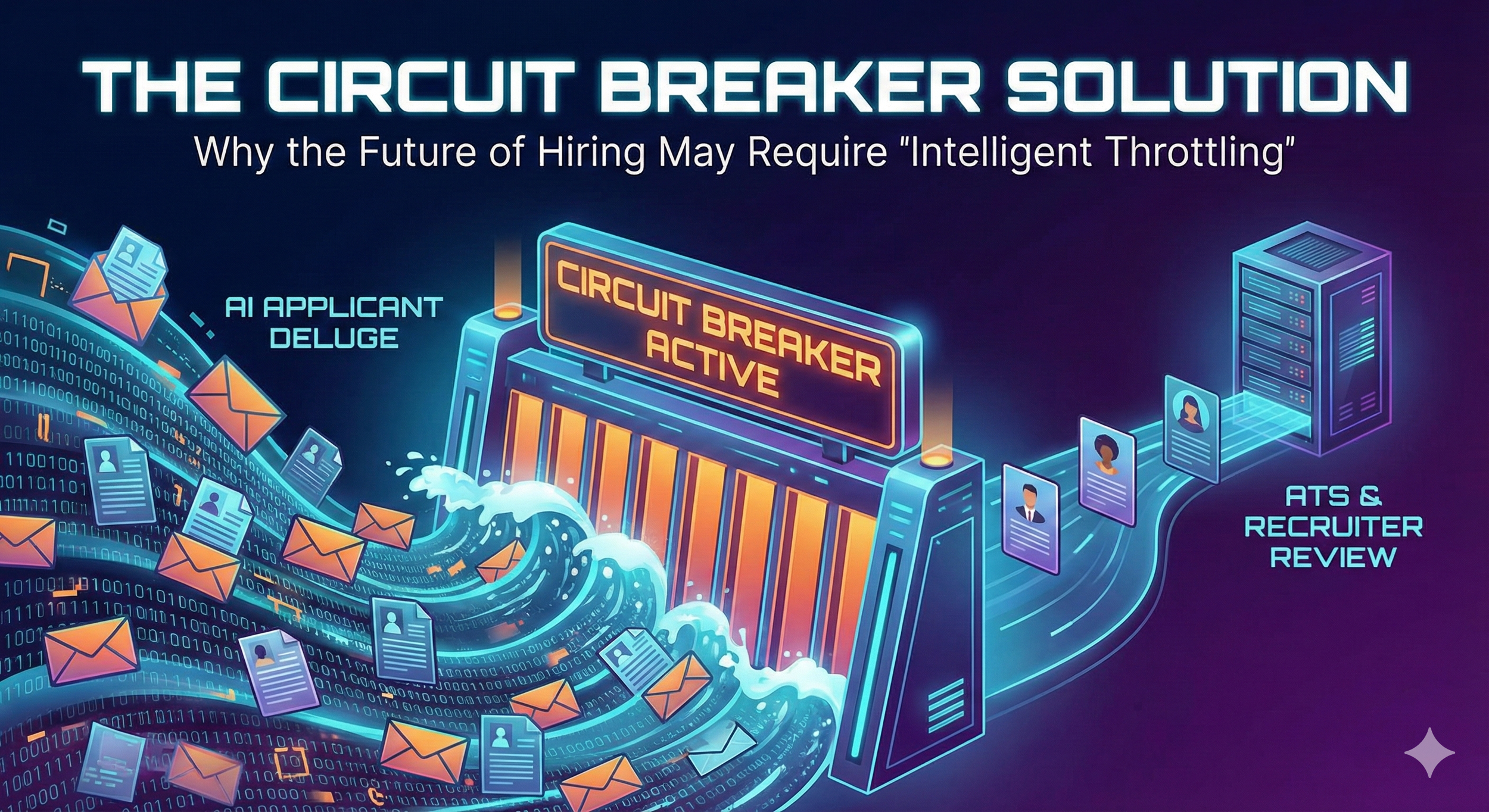
The Monday morning scene for a modern recruiter often looks like a digital disaster movie. You open a requisition on Friday afternoon. By 9:00 AM Monday, your ATS dashboard isn't just busy; it’s hyperventilating. 3,000 applicants. For one mid-level role.
We are living through a unique convergence in the labor market. A wave of high-profile layoffs has created a massive pool of eager talent. Simultaneously, generative AI has democratized corporate-grade automation for the individual job seeker. Tools that auto-apply, perfectly tailor resumes to keywords in milliseconds, and blast applications across platforms are now commonplace.
We have removed all friction from applying. The result isn't a talent pool; it's a talent deluge.
The Current Defense: Identity vs. Volume
Employers and ATS vendors are realizing that the old floodgates cannot hold. We are seeing the first signs of a defensive build-up.
Recent moves, like Greenhouse Software partnering with CLEAR for verified identity, are excellent steps toward combatting outright fraud. They ensure the person applying is a real human being, not a bot farm or a bad actor trying to phish corporate data.
But solving for identity does not solve for volume.
5,000 verified, real human beings applying to a job in 24 hours is still an unmanageable crisis for a human recruiting team. It leads to reviewer fatigue, inevitable "ghosting" (because who can send personalized rejections to thousands?), and a degradation of the candidate experience for everyone involved.
If the candidate side is using AI designed for speed and volume, the employer side needs an AI countermeasure designed for pacing and control.
The Future Concept: Intelligent Job Throttling
The next necessary evolution in ATS technology might be controversial, but it seems increasingly inevitable: AI-driven velocity throttling.
Imagine an ATS feature that functions like a stock market circuit breaker.
When the stock market crashes too fast, trading is automatically halted to allow cool heads to prevail and prevent panic. Why don't our job postings have the same mechanism?
How it might work:
An AI layer within the ATS monitors incoming application velocity against historical benchmarks for similar roles.
Scenario: A remote marketing manager role usually gets 50 apps on Day 1. Today, it receives 400 applications in the first hour due to an AI-applier tool targeting the post.
The Trigger: The ATS recognizes this anomalous velocity.
The Throttle: The AI automatically initiates a tiered response without human intervention:
Tier 1: The job posting is immediately de-indexed from free aggregators (Indeed, LinkedIn feed, etc.).
Tier 2: The "Apply Now" button on the career site changes to "Join Talent Community Waitlist."
Tier 3: The requisition is temporarily paused entirely, becoming invisible externally until the recruiter reviews the initial batch.
The uncomfortable Necessity
The immediate reaction to this idea from job seekers will likely be frustration. It feels like creating artificial scarcity. It feels unfair to the person who wasn't at their computer at the exact moment the job went live.
However, we must confront the reality of the alternative.
If a recruiter has 3,000 applications, they are likely only reviewing the first 100-200 anyway before they find enough qualified candidates for phone screens. The remaining 2,800 people are already being functionally "throttled"—they just don't know it yet. They are left hoping for an email that will never come.
Intelligent throttling offers a difficult but perhaps more honest approach. It stops accepting applications when the capacity to review them humanely has been exceeded. It protects the recruiter’s bandwidth, ensuring the candidates who did get in receive actual consideration, rather than a 3-second glance.
The AI Arms Race Continues
We are in the midst of a great re-balancing of power in hiring, driven by artificial intelligence. As soon as one side gains a technological advantage in speed, the other side must develop a countermeasure.
If candidates are going to use AI to accelerator pedals to the floor, employers have no choice but to install AI-powered brakes. Intelligent throttling may soon move from a hypothetical concept to an essential survival tool for the modern Talent Acquisition department.