
web
analytics

career sites

How AI is Reshaping Career Sites and Employer Branding

Brianna Huynh
Appcast

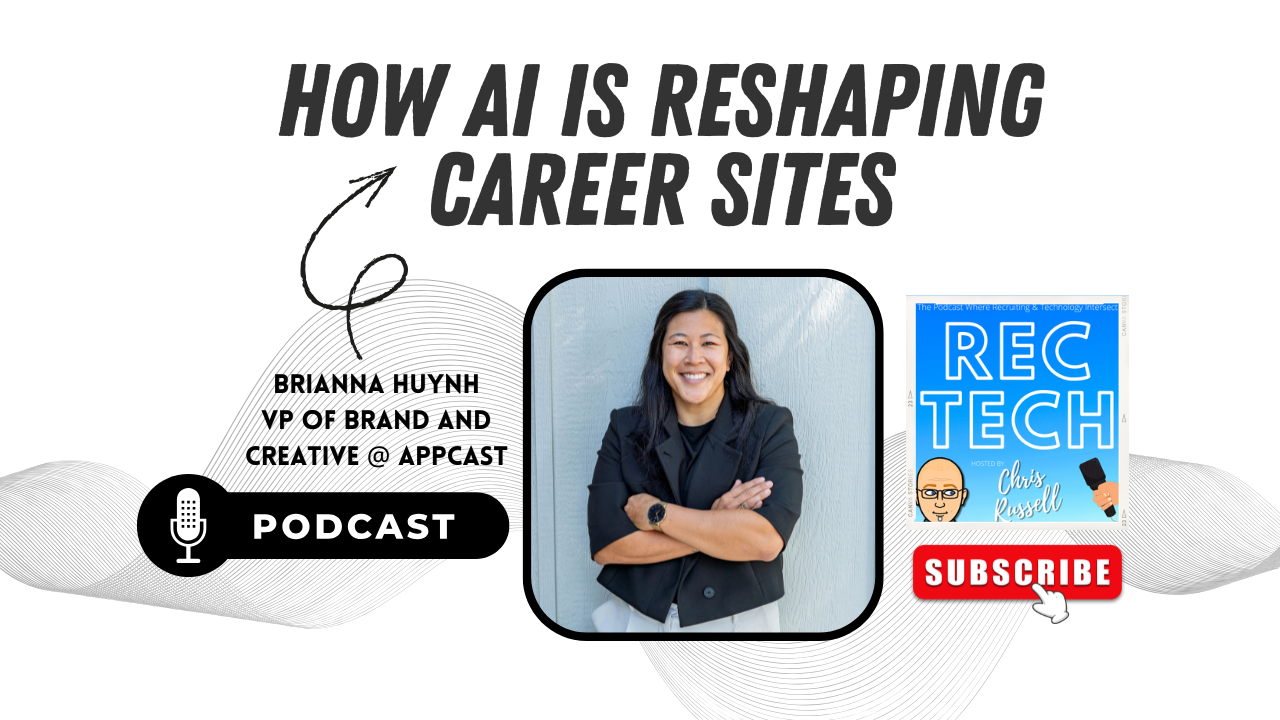
On a recent episode of the RecTech podcast, host Chris Russell sat down with Brianna Huynh, VP of Brand and Creative at Appcast, to discuss how generative AI is shifting candidate behavior and altering how companies should approach their career sites and employer branding.

Candidates aren't just scrolling through traditional job boards anymore—they are turning to AI tools like ChatGPT and Gemini to discover roles, evaluate company culture, and summarize job opportunities. Because of this, career sites are no longer read solely by humans; they are now parsed, filtered, and judged by AI.

Here are the key takeaways from their conversation:

1. Traditional SEO vs. Generative Engine Optimization (GEO)

  • SEO is deterministic; GEO is probabilistic: With traditional SEO, practitioners adjust specific factors to reliably climb rankings and capture clicks. With GEO and AI-driven discoverability, prompting a tool ten times can yield ten different answers. Rather than trying to "game" a ranking, the goal becomes securing recommendations and ensuring accurate representation.

  • The 80% rule: Huynh notes that technical GEO relies heavily (about 80%) on sound SEO foundations. If a site has strong technical SEO, it is more likely to perform well with AI scrapers.

  • Context is king: The remaining 20% comes down to deep context, real relationships, and answering specific questions. Tools like employee testimonials and structured FAQs go a long way with AI models seeking clear, direct answers.

2. The Danger of Vague Job Descriptions

Relying on generic phrases such as "competitive salary" or "dynamic culture" creates major blind spots:

  • When an AI cannot find clear, concrete data on your career site, it doesn't give up. Instead, it scrapes third-party sources—like Glassdoor, Indeed reviews, and Reddit threads—to fill in the blanks.

  • The AI will present those subjective reviews as factual answers to candidate prompts.

  • Employers must close the brand narrative gap by publishing transparent details regarding compensation, benefits, and team expectations directly on their own sites so AI models pull from accurate, first-party data.

3. Human Experience vs. AI Architecture

When designing a modern career site, should you cater to algorithms or people?

According to Huynh, the answer is both, but for different layers of the experience:

  • Design the front end for humans: Job seekers still want rich media, authentic video testimonials, engaging photography, and an intuitive application flow.

  • Structure the back end for AI: Use structured schema markup, clean headers, and labeled data so search robots and AI crawlers can effortlessly ingest, understand, and summarize the site's content.

4. Who Owns the Career Site?

As career sites become more technical and strategic, Russell and Huynh touched on who within an organization should lead the effort:

  • Talent Acquisition (TA): Holds primary ownership and accountability for site performance and candidate conversion.

  • Marketing / Corporate Communications: Shapes the storytelling, brand voice, and overall narrative.

  • IT: Ensures technical compliance, accessibility, and site security.

Quick Wins: How TA Leaders Can Optimize Today

If you run an audit on platforms like ChatGPT, Gemini, or Claude and find your company’s career site is invisible or misrepresented, consider these first steps:

  1. Implement structured schema markup: Work with your career site provider or web development team to ensure headers, job descriptions, and company details are clearly marked up on the back end for crawlers.

  2. Address content gaps head-on: If AI summaries are surfacing negative or incomplete reviews regarding compensation or culture, build dedicated landing pages that directly and transparently address those topics.

  3. Use AI to edit, not invent: Avoid letting generative AI fill job posts with fluff. Instead, use AI to refine and polish real, detailed specifics provided by hiring managers.


Get the Podcast | Subscribe

How to Optimize Your Career Site for the AI Ecosystem

In a landscape where candidates increasingly turn to Large Language Models (LLMs) like ChatGPT, Claude, and Gemini to find their next role, the traditional rules of SEO are shifting. According to employer brand expert James Ellis, being found by talent today requires a new strategy: ensuring AI can find you, understand you, and trust what it finds.

Here are the key takeaways from Ellis on how to turn your career site into a high-performing AI search asset.

1. Give Your Company a Real Entity Homepage

Most Fortune 500 career sites fall into the trap of "cookie-cutter" messaging, using generic phrases about growth and purpose that make every company sound the same.

  • Take Ownership: Unlike third-party platforms, you own your career site and its domain authority.

  • Stand Out: Avoid "recruiting-speak" and "legal-speak". Use your site to clarify exactly what your company offers in a way that LLMs can distinguish from your competitors.

2. Make Your Claims Auditable

AI systems value evidence over empty marketing claims. If you claim to have a culture that "cares," you must provide proof.

  • Use Specific Examples: Ellis suggests moving beyond bullet points to include short, two-sentence stories or testimonials from employees.

  • Provide Data: Tangible proof—such as a specific policy or the amount spent on an employee benefit—serves as undeniable evidence for an AI to rank your company as a credible answer to a user's prompt.

3. Build Durable Pages, Not Disposable Posts

A common mistake is placing all high-quality content inside job postings that expire and disappear after 30 days.

  • Perpetual Evidence: LLMs look for evidence that is perpetual and evolving.

  • Reinforce Your Story: While job postings are important for initial impressions, that content should also live permanently on your career site to reinforce your brand pattern across the web.

4. Leverage Structured FAQs and Q&As

FAQs are "low-hanging fruit" that provide the context LLMs crave.

  • Feed the AI Context: LLMs struggle with ambiguity (e.g., distinguishing "CAT" the animal from "CAT" the tractor company).

  • Be Specific: Instead of a generic "What is it like to work here?", use detailed questions like "What is the day-to-day for a claims adjuster in our Chicago office?". This allows the AI to play a better "matching game" with user queries.

5. Prioritize Living, Fresh Content

Your career site should not be a static archive; it needs to show "signs of life".

  • Incremental Changes: You don't need a radical redesign every year. Instead, make small, weekly updates: swap a headline, add a new video, or refactor a company news story into a candidate-facing update.

  • Fractal Branding: Ensure your core value proposition is present in every sentence. If innovation is your brand, it should be indicated throughout the site, not just in a single headline.

Measuring Success in the AI Age

As search shifts away from simple link lists, traditional ranking becomes less relevant. Employers should focus on citation visibility and traffic coming directly from LLMs in their analytics. By narrowing your focus to be intensely appealing to your specific target audience, you ensure that when an engineer asks an AI for the best place to work in Chicago, your company is the one that gets the recommendation.

How are you currently adapting your recruitment content to ensure it is "understandable" to AI?


Get the Podcast | Subscribe

Is your career site killing your recruiting game?

How's your career site these days? If you are an employer who is looking to up their game this audio will give you some great ideas and examples to look up to. Recorded live at RecruitCon Boston.


Get the Podcast | Subscribe