
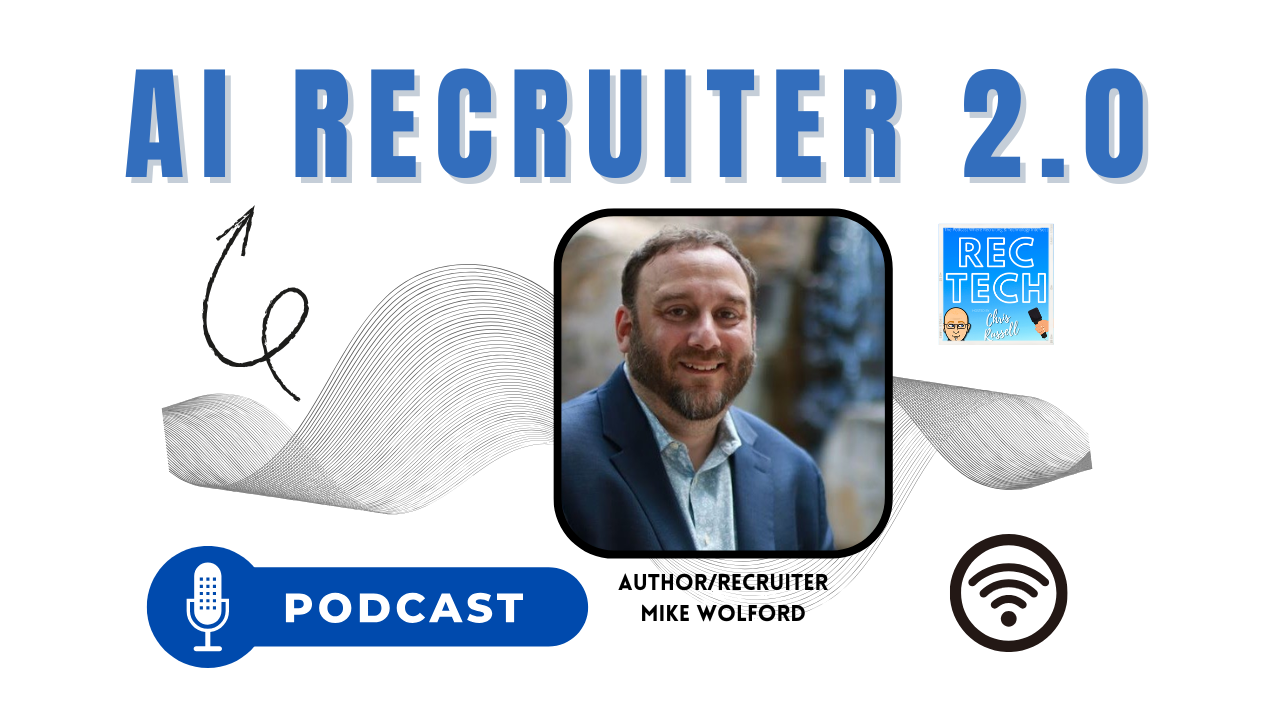
In a recent podcast episode, Michael Wolford, author of AI Recruiter 2.0, discussed how artificial intelligence is revolutionizing the recruiting industry by automating administrative tasks and empowering recruiters to focus on what they do best: building relationships and adding real value1.
The Vision: Freeing Recruiters to Focus on People
Michael's core philosophy is straightforward: use AI to eliminate administrative burden so recruiters can spend their time on high-value activities1. Rather than drowning in scheduling, feedback tracking, and prospect research, recruiters can:
Advocate for candidates through interview prep and guidance
Act as business advisors equipped with data and solutions to help hiring managers make informed decisions
As Michael notes, this shift not only improves job satisfaction but also enhances recruiter effectiveness. One example highlighted was a recruiter named Jordan, whose mental energy shifted from administrative tasks to meaningful interactions with people—transforming her job experience1.
2026: The Age of Empowerment
Michael identifies 2026 as a pivotal moment where recruiters no longer need to wait for vendors to build the "perfect tool." Instead, they can build customized solutions themselves1.
Building Recruiting Apps Without Coding
A prime example is Prospect Pro, an app Michael built to automate Boolean searches and email synthesis from publicly available data1. Using tools like:
LM Arena — Free access to all major AI models
Gemini 3 Pro — For technical planning and guidance
Lovable — A no-code platform for building web apps
Michael created a fully functional sourcing app that:
Automates Boolean searches on Google
Synthesizes email addresses for prospects
Generates CSV exports with names, titles, companies, and contact info
Reduced manual sourcing time from hours to minutes1
Remarkably, his first app build took five hours; now he can build similar applications in just 1.5 hours1.
The Prompt Pyramid: Mastering AI Communication
To get quality results from AI, Michael emphasizes the importance of the "prompt pyramid," which consists of five layers1:
Task — What you want done
Context — Defining the AI's persona and target audience (the most critical missing piece)
Constraints — Limitations or specific requirements
Example — Sample outputs to guide the AI
Output — The desired format
The context layer is particularly important because AI works through statistical language models that map word relationships mathematically1. Without context about who the AI is speaking to and why, results become generic and repetitive.
Real-World Impact: Candidate Pitches and Outreach
AI-Generated Candidate Summaries
Michael demonstrated how AI can elevate recruiter output. A well-structured prompt can generate:
Professional candidate summaries
Match percentage tables comparing candidate qualifications to job requirements
Quantitative proof points that help hiring managers say "yes"1
Outreach Response Rates
LinkedIn data shows compelling results1:
Human recruiter outreach: 22% response rate
AI-generated outreach: 31% response rate
Looking forward, Michael predicts AI will become even more sophisticated, personalizing not just message content but also timing, channel, and tone based on candidate behavior patterns1.
Creative Personalization
During the podcast, Michael demonstrated real-time email generation with creative constraints—writing in Yoda's voice with emojis—showing how AI can produce engaging, personalized outreach at scale1.
Beyond Recruiting: Creative Use Cases
Recruiters are already discovering innovative applications1:
Automating entire interview processes with suggested questions and rubrics
Company-wide skills assessments to identify organizational gaps
Rediscovery agents using API/MCP keys to search entire ATS databases beyond typical limits, enabling tailored filtering by recruiter-defined criteria1
The Future: Agentic AI Replaces SaaS
Michael predicts that AI agentic apps will replace traditional SaaS vendors due to lower costs and faster deployment1. This shift creates a new job opportunity: the Prompt Engineer—professionals who can translate domain expertise into effective AI prompts without writing code1.
Michael's Final Advice
As Michael concludes, the path forward is clear1:
Document your current manual recruiting processes
Automate them with AI tools
Focus on value, not effort — Nobody cares how hard you work; they care about results
In a world where AI can handle the administrative heavy lifting, job security comes from adding genuine value to candidates, hiring managers, and your organization.
About the Guest
Michael Wolford brings deep recruiting expertise, having worked in agency recruiting, managed sourcing teams at Twitter (2021-2022), and written extensively for SourceCon and Recruiting Daily for nearly a decade1. He's authored multiple books on AI in recruiting and is the founder of what is becoming Generative Sales Pro (formerly Lex Duo).