
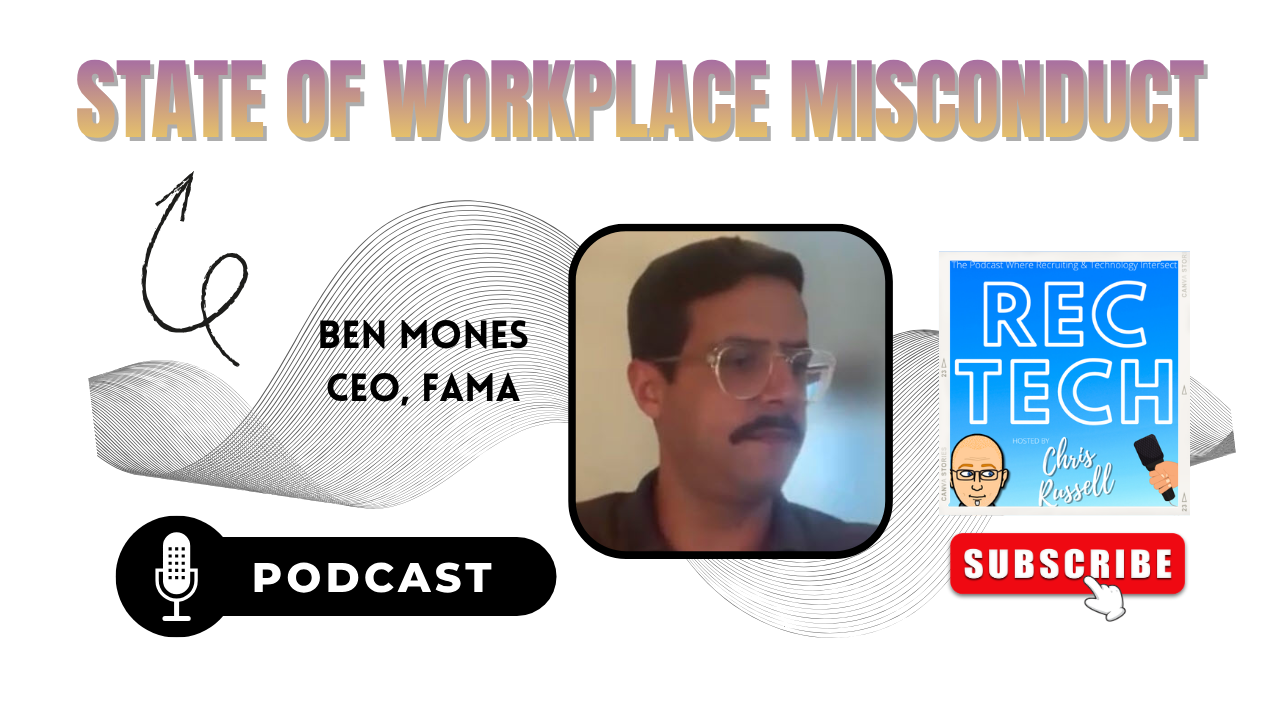
A Conversation with Ben Mones, CEO of Fama Technologies
The workplace has changed dramatically. Your screening process should too.
In a recent conversation on the RecTech Podcast, Ben Mones, CEO of Fama Technologies, shared eye-opening insights about the state of workplace misconduct and why employers are falling behind in their talent vetting practices. With 11 years in the screening space, Ben has a front-row seat to how digital transformation is reshaping hiring—and what companies need to do to protect themselves.
The Numbers Don't Lie: Misconduct Is On the Rise
Fama's latest "State of Misconduct at Work" report reveals a startling trend: there's been a 34% year-over-year increase in online misconduct signals. We're not just talking about isolated incidents. Across industries, roughly one in 15 candidates screened shows some form of misconduct signal—whether it's trolling, violence, threats, or references to illegal drug use.
"Misconduct is on the rise writ large," Ben explains, pointing to the fundamental shift in how work happens today. With remote and hybrid work becoming the norm, employees are getting to know each other through Discord, Reddit, LinkedIn, and other digital channels rather than around the office water cooler. That digital footprint tells a story—and employers need to be reading it.
The Unexpected Culprit: LinkedIn
Here's something that might surprise you: LinkedIn has become ground zero for online misconduct, experiencing the biggest explosion of problematic behavior.
"I'm starting to see it as much more of a sewer," Ben says candidly. When Twitter faced upheaval under new ownership, many users migrated to alternative platforms like Bluesky and Mastodon. But eventually, they found their way to LinkedIn—bringing their unfiltered behavior with them. The result? A platform once known for polished professional networking is now seeing harassment, inappropriate advances, and other problematic content at scale.
Your Workforce Has Changed—Has Your Screening?
With six generations now in the workforce, the demographic makeup of talent has shifted dramatically. Half the workplace is now made up of Gen Z and millennials—digital natives who have spent their entire lives online. For these candidates, their social media history is often richer and more revealing than any traditional background check.
Ben uses a vivid metaphor: "Are you screening like it's 1999 on Windows XP, or are you screening on a MacBook Pro with Claude and Gemini?"
The point is clear: if your screening strategy hasn't evolved to match your workforce, you're operating with incomplete information.
The Real-World Impact
Chris Russell, the podcast host, shared a powerful anecdote that illustrates why this matters. Before hiring someone for a financial role with access to sensitive data and credit cards, he did a simple Google search on the candidate's name. He found an article mentioning that the person had been caught stealing from someone's purse at a school. When confronted, the candidate admitted it.
That's the kind of critical information that can be hiding in plain sight—if you know where to look.
Technology Is Smarter Than You Think
One of the biggest misconceptions about social media screening is that it's just keyword matching. That's outdated thinking. Modern AI has evolved dramatically.
Today's systems can distinguish between "My boss and I are going to kill it on this project" and "I'm going to kill my boss after I wrap up this project.". The difference matters—and sophisticated AI now understands context in ways that simple keyword searches never could.
How Employers Are Actually Using This
About 80% of Fama's clients use social media screening during the final candidate shortlist—typically when they're down to three or four people and ready to extend a conditional offer. This positions screening as a complement to traditional background checks rather than a replacement.
Interestingly, about 20% of their clients are also doing ongoing employee re-screening, monitoring for regulated behaviors like workplace harassment, violence, or threats.
Privacy First: Consent and Compliance Matter
A common concern: isn't this invasive? The answer is nuanced.
All legitimate screening should be fully compliant with FCRA and GDPR regulations, with explicit candidate consent. Importantly, candidates get to see the results and explain themselves—just like any other background check. This isn't a black-box process; it's a conversation.
And here's the surprising part: when employers are transparent about their screening practices, most candidates appreciate it. People want to work somewhere that screens for intolerance, harassment, and illegal drug use. It signals that the company takes its values seriously.
Beyond Binary: The Future of Screening
Traditional background checks are binary. You either have a conviction or you don't. But social media screening is different—and that requires a different approach.
A candidate posting one tasteless joke is different from someone with a pattern of offensive behavior over years. Employers need room for nuance and judgment. This is where the future of screening is headed: away from rigid, automated decisions and toward explainable, behavior-based AI systems that track candidates over time.
Ben envisions a future where screening provides longitudinal insights—understanding not just who someone is at one moment in time, but how they've evolved, what patterns emerge, and what that might predict about their future behavior in your organization.
What Employers Should Do Now
Ben's recommendations are straightforward:
Don't change your why. You still have clear values and standards. The question is whether your screening process reflects them.
Review your code of conduct. Is it just a document employees sign off on, or do you actually enforce it? Screening is a way to make those values real.
Lean into compliance, not away from it. Be transparent with candidates about what you're screening for and why. Most will respect you for it.
Adapt your screening sources. For a workforce that's largely digital natives, social media screening should be part of your toolkit—just like reference checks or background checks.
The Bottom Line
Workplace misconduct is rising, and it's happening in the digital spaces where your future employees spend their time. The question isn't whether to screen for it—it's whether you're screening in the right places, using the right tools, and doing it in a way that's both compliant and fair.
As Ben puts it: your screening strategy should be reflective of the workforce you're actually hiring, not the one you hired 20 years ago.