
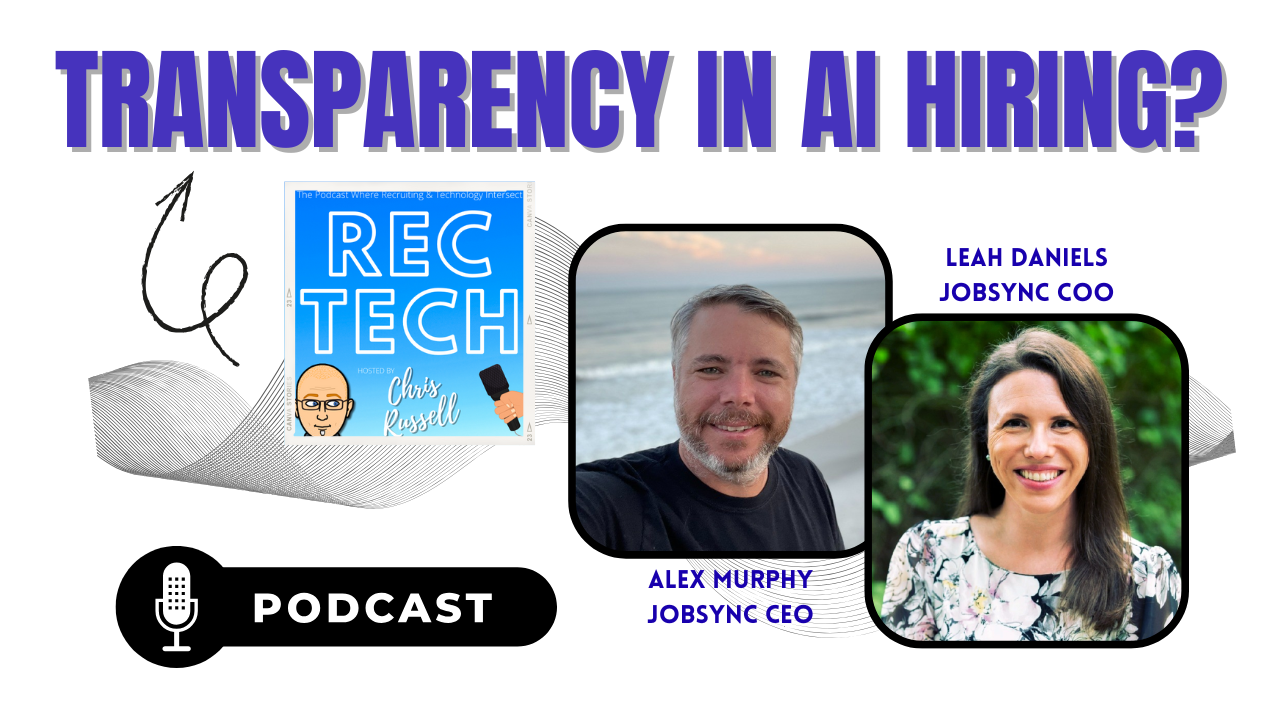
The recent Eightfold AI class action lawsuit is making waves in the recruitment technology industry, but it's not really about AI—it's about data protection and personal data sovereignty. In today’s podcast, industry experts Alex Murphy (CEO of JobSync) and Leah Daniels (COO of JobSync) break down what this lawsuit means for vendors, employers, and job seekers alike.
The Core Issue: Hidden Dossiers and FCRA Violations
In January 2026, plaintiffs filed a class action lawsuit against Eightfold, alleging violations of the Fair Credit Reporting Act (FCRA) for creating undisclosed consumer credit reports on job seekers. The company allegedly scraped personal data from third-party sources like GitHub and LinkedIn to rank applicants without providing transparency or allowing candidates to dispute the information.
"It's really around data and data protection and call it personal data sovereignty," Murphy explained. "We can build technology, but it actually has to be done inside the scope of what the law of the land is."
Not All AI Is the Problem
An important distinction: this lawsuit isn't about AI scoring itself, but about how vendors use undisclosed external data to influence hiring decisions. As Daniels points out, "Not all AI is going to fall under this... An AI that rewrites your job description is unlikely to be swept up in this particular lawsuit."
The problem arises when vendors create what Daniels calls "secret dossiers"—secondary sets of data about candidates that they use for evaluation without the candidate's knowledge or ability to correct it. This is particularly dangerous because of data accuracy issues. "People with the same name, especially like a junior and a senior, could go to the same university, could even have worked at the same company. That will confuse most technology into thinking it's the same person when it is not," Daniels warns.
The FCRA Requirements Are Clear
The regulations governing consumer reports are extraordinarily specific. A simple checkbox on an application form is insufficient compliance. "The law is actually really clear about the fact that it has to be a separate document from the application. So you can't sneak it into like a check the box type of exercise," Murphy explains.
Once this lawsuit puts the industry on notice, ignorance is no longer an excuse. "You don't have that excuse anymore," Murphy states, suggesting that vendors and employers now have clear warning that compliance is mandatory.
The Transparency Problem: Easier Said Than Done
While transparency seems like an obvious solution, it creates its own challenges. If vendors must disclose the AI models and training data used to score candidates, how can they explain a black-box algorithm to job seekers? And if candidates can dispute scores, does that eliminate the efficiency gains that AI scoring was supposed to provide?
"If I score a hundred people and ten of them get a ninety and better and the other ninety get a ninety or lower, you're going to have ninety people disputing the score," Daniels notes. "That has not created any efficiency for the recruiting teams. That has created nothing but inefficiency."
Leah predicts that upfront scoring algorithms may disappear entirely as a result of these transparency and dispute requirements.
The Resume Arms Race: AI vs. AI
Adding another layer of complexity, job seekers are increasingly using AI to generate and optimize their resumes. This creates a problematic feedback loop: when AI-written resumes are evaluated by AI scoring algorithms, the result may simply be the most cleverly optimized prompt, not the best candidate.
"When one AI evaluates the quality of a resume as a match for the job posting when that resume was written by another AI, the AI says that's a really, really good match. That's what I would have written had I written that resume," Murphy explains.
Job Seeker Empowerment: New Models Emerging
Some platforms are taking different approaches to help job seekers stand out. Greenhouse has introduced "dream jobs"—free tokens that allow candidates to signal strong interest in a position. ZipRecruiter is bringing back cover letters as a way for candidates to highlight their interest. Indeed is testing paid priority placement in Canada.
However, there's speculation about where these models will lead. "I wonder how long it'll take before they are tempted with, 'Oh, but a second token costs you 20 and you can buy three for 50,'" Murphy muses. While Greenhouse currently operates in the enterprise software business rather than charging job seekers, the financial temptation may eventually prove irresistible.
What TA Leaders Need to Do Now
The implications for talent acquisition leaders are significant. They need to become more technically sophisticated in evaluating vendors and asking harder questions about data usage.
"TA leaders need to be much more technical. They have to ask a lot more questions. How, where, why? What will that do for me? What's the risk?" Daniels advises.
Specifically, leaders should understand the distinction between data controllers and data processors—a concept more familiar in Europe but increasingly critical in the U.S. "If you have any experience or any exposure in Europe, that is actually a thing that you really do completely need to understand," Murphy notes.
The Bigger Picture: A Broken Hiring Market
Beyond the lawsuits, both experts agree the entire hiring marketplace is fundamentally broken for everyone involved. The economy's uncertainty, geopolitical concerns, and post-COVID overhiring have created a hiring environment driven by replacement needs rather than growth.
"How does anybody make any decision to commit and hire a big group of people and a team of people? At best, really what you're doing is you're doing replacement hiring," Murphy observes.
What's Coming Next
The Eightfold lawsuit represents a watershed moment. While the Workday-Mobley lawsuit may favor the employer, the Eightfold claims appear much stronger given the company's marketing materials about using third-party data sources.
The industry should prepare for stricter regulatory scrutiny. Vendors must implement transparent candidate data disclosure and dispute processes similar to FCRA requirements for any AI hiring tools that collect or utilize third-party candidate data. And TA leaders should be ready to ask tougher questions about vendor compliance and data protection.
One thing is certain: the days of hidden dossiers and opaque AI scoring are numbered.